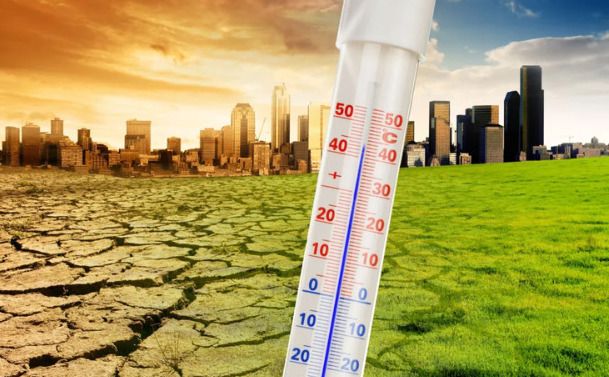
According to the World Meteorological Organization (WMO), since the 1980s, every subsequent decade has been warmer than any of the previous decades in the entire history of observations, which has been conducted since 1850. The period 2006-2025 is estimated as the warmest 20-year period in the entire history of observations, and all 10 of the warmest years on a global scale occurred in the 21st century.
The rate of warming is distributed unevenly across the planet: in some regions, especially in the middle and high latitudes, temperature increases are much more intense. In the period 1976-2025, the growth rate of the average annual air temperature in Kazakhstan averaged +0.40 °C over 10 years. This is about twice the rate of global warming (~+0.18–0.20 °C in 10 years). 2025 was the warmest year in Kazakhstan since 1941. The anomaly of the average annual air temperature relative to the climatic norm of 1961-1990 was +2.96 °C.
Kazakhstan is located in the center of the Eurasian continent, far from the oceans, so its climate is sharply continental. The weak regulatory influence of the oceans and the peculiarities of the continental climate contribute to a more pronounced manifestation of warming in the country.
The rate of warming in Kazakhstan varies depending on the region and season: the annual temperature trend is about +0.29 °C over 10 years in the Karaganda region and reaches +0.59 °C over 10 years in the West Kazakhstan region. The highest rate of warming is observed in spring — about 0.70 °C in 10 years.